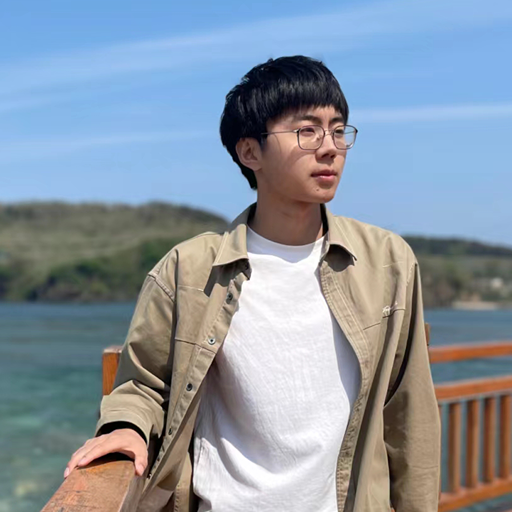
I am currently a Ph.D. candidate in Tianjin Key Laboratory of Visual Computing and Intelligent Perception (VCIP) and Media Computing Lab (MCLab) at the College of Computer Science, Nankai University, supervised by Prof. Ming-Ming Cheng and Prof. Qibin Hou. Prior to this, I completed seven years of undergraduate and master's studies at Dalian University of Technology (DUT).
I am currently a Qingyun Program Intern at Tencent Hunyuan (March 2026–present), contributing to the development of Hunyuan Hy3 and Hy4, with a focus on multimodal post-training, efficient embodied foundation models, and physical-world agents. Previously, I was a Research Intern at ByteDance's Volcano Engine Multimedia Laboratory (November 2024–March 2026), focusing on reinforcement post-training for video MLLMs and their deployment in VOD and live-streaming applications.
My current research interests focus on multimodal large language models, reinforcement-learning post-training, adaptive agents, and open-world perception.
I am dedicated to contributing to open-source projects, and my work can be found in HVision-NKU. Additionally, I maintain a list of Awesome Open-Vocabulary Semantic Segmentation resources.
If you're interested in my research or have any research-related questions, please feel free to contact me via email at yunhengli [at] mail.nankai.edu.cn or yunheng.li.21 [at] gmail.com.
💼 Experience
-
March 2026 – Present · Qingyun Program Intern, Tencent Hunyuan
Participating in the development of Hunyuan Hy3 and Hy4, with a focus on multimodal post-training, embodied perception, and long-horizon reasoning. I also contributed to Hy-Embodied-VLM-1.0, an MoE vision-language model that activates only 3B parameters. -
November 2024 – March 2026 · Research Intern, ByteDance (Volcano Engine Multimedia Laboratory)
Developed TempSamp-R1 for reinforcement fine-tuning of video MLLMs. The framework achieved state-of-the-art temporal grounding results and enabled intelligent highlight detection and automated video editing in ByteDance/Volcano Engine VOD and live-streaming applications.
📚 Publications
* Equal contribution. # Corresponding author
Preprint
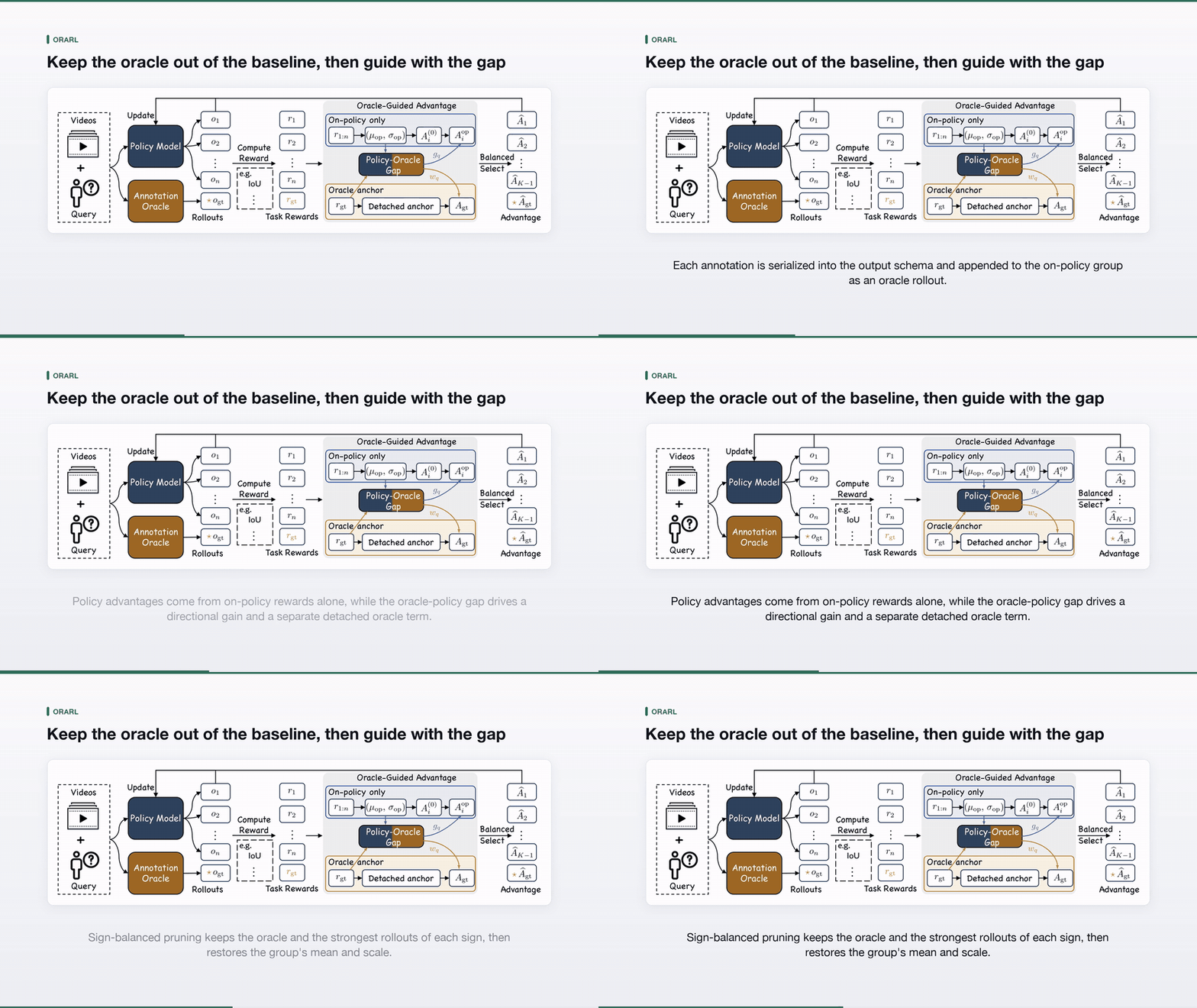
Annotations as Rollouts: Efficient and Scalable Reinforcement Learning for Video MLLMs
Yunheng Li, Guohong Mu, Hao Li, Shengsheng Qian, Dingwen Zhang, Qibin Hou#, Ming-Ming Cheng
OraRL turns each annotation into an oracle rollout while preserving on-policy exploration, enabling one Video-ORA model to cover seven video-perception task families. Video-ORA-9B achieves state-of-the-art results without chain-of-thought decoding while delivering 1.48× faster updates and 36.8× faster answer decoding.
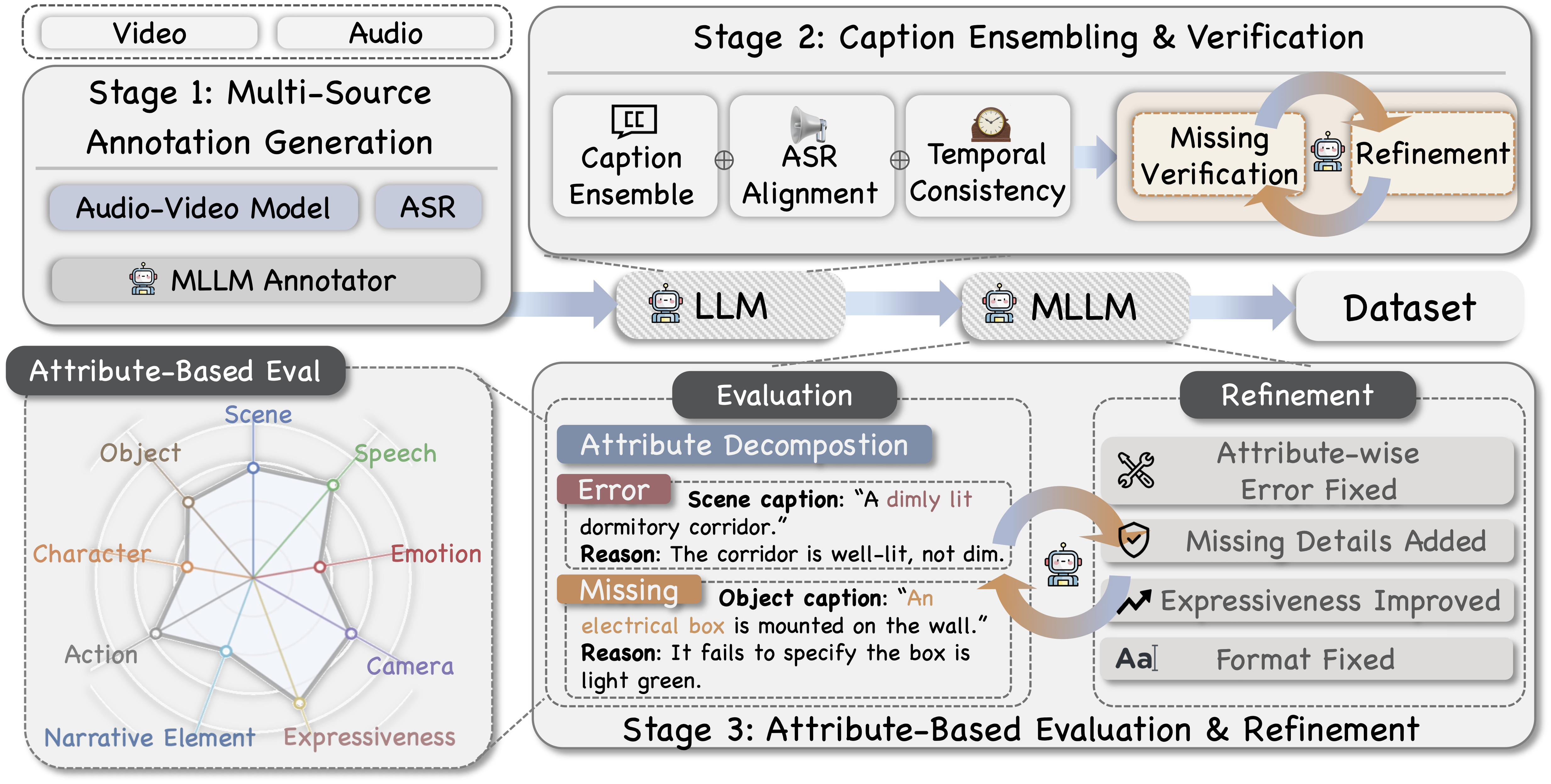
Towards Universal Video MLLMs with Attribute-Structured and Quality-Verified Instructions
Yunheng Li, Hengrui Zhang, Meng-Hao Guo, Wenzhao Gao, Shaoyong Jia, Shaohui Jiao, Qibin Hou#, Ming-Ming Cheng
We introduce ASID-Caption, a data-and-model suite for fine-grained audiovisual video understanding, including a large-scale attribute-structured dataset (ASID-1M), a quality-verification pipeline (ASID-Verify), and Omni–based captioning models (ASID-Captioner).
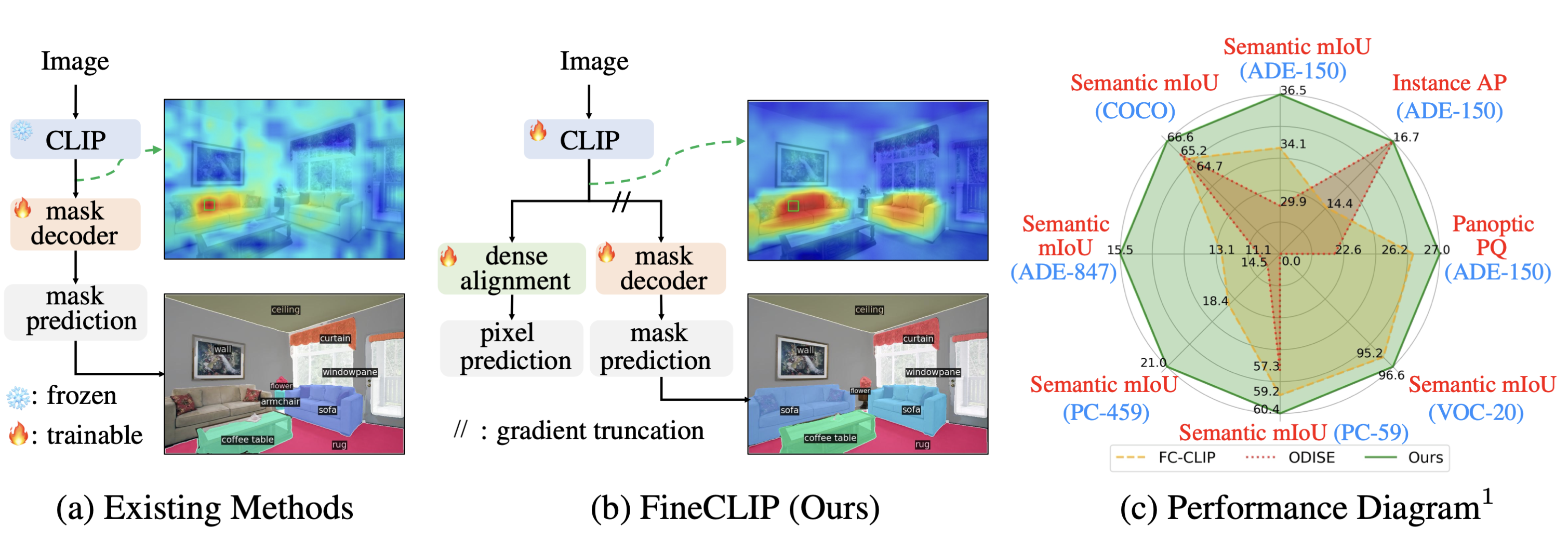
Align Before Segment: Understanding Visual Encoder Fine-tuning for Open Vocabulary Segmentation
Yunheng Li, Quansheng Zeng, Zhong-Yu Li, Enguang Wang, Qibin Hou#, Ming-Ming Cheng
FineCLIP is an align-before-segment framework that fine-tunes CLIP with dense image-text alignment, notably enhancing open-vocabulary segmentation performance.
Technical Reports
Hy-Embodied-VLM-1.0: Efficient Physical-World Agents
Ziyi Wang, Xumin Yu, Yongming Rao, Yonggen Ling, Yunheng Li, et al.
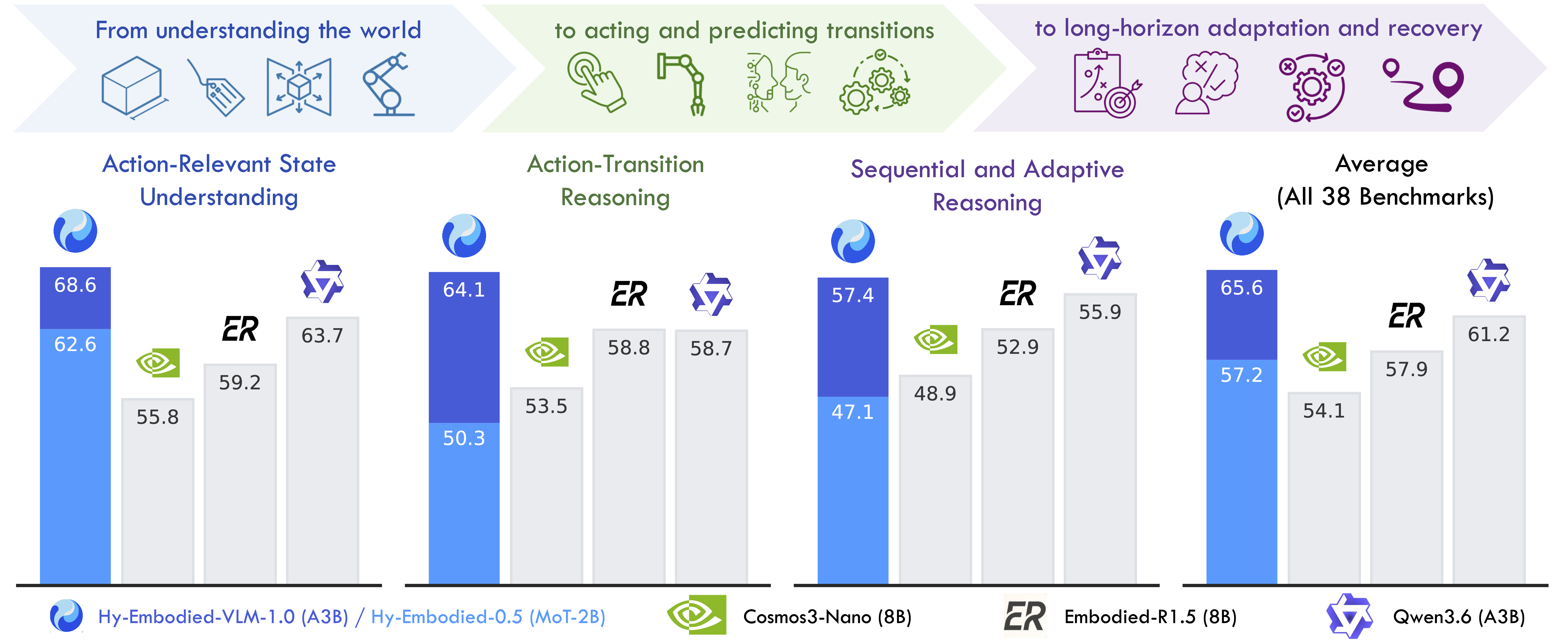
Hy-Embodied-VLM-1.0 is an efficient MoE vision-language foundation model for physical-world agents. It activates only 3B parameters while supporting action-centric perception, multi-turn interaction, and long-horizon embodied reasoning.
Conference
TempSamp-R1: Effective Temporal Sampling with Reinforcement Fine-Tuning for Video LLMs
Yunheng Li, Jing Cheng, Shaoyong Jia, Hangyi Kuang, Shaohui Jiao, Qibin Hou#, Ming-Ming Cheng [Paper] [Code] [Huggingface] [字节跳动技术团队]
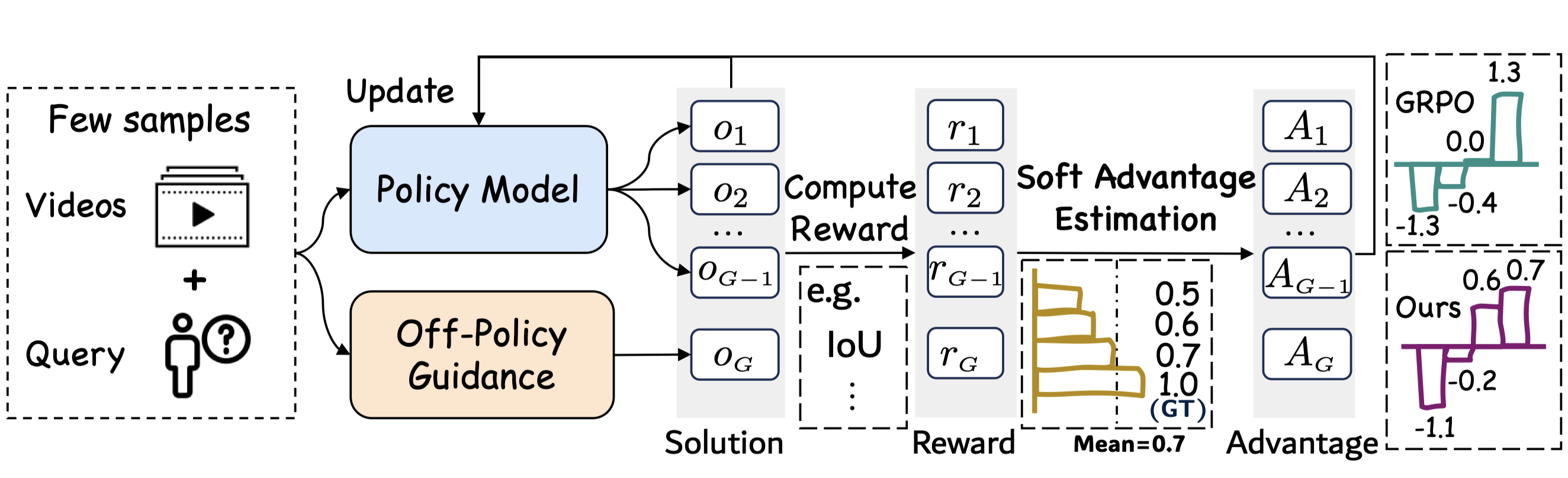
TempSamp-R1 leverages ground-truth annotations as off-policy supervision to provide temporally precise guidance, effectively compensating for sparse and misaligned on-policy solutions in video MLLMs. The framework achieved state-of-the-art results on Charades-STA, ActivityNet Captions, and QVHighlights, and enabled intelligent highlight detection and automated video editing in ByteDance/Volcano Engine VOD and live-streaming applications, including short-drama, sports, and e-commerce scenarios.
Unbiased Region-Language Alignment for Open-Vocabulary Dense Prediction
Yunheng Li, Yuxuan Li, Quansheng Zeng, Wenhai Wang, Qibin Hou#, Ming-Ming Cheng
[Paper] [Code] [Huggingface] [中译版]
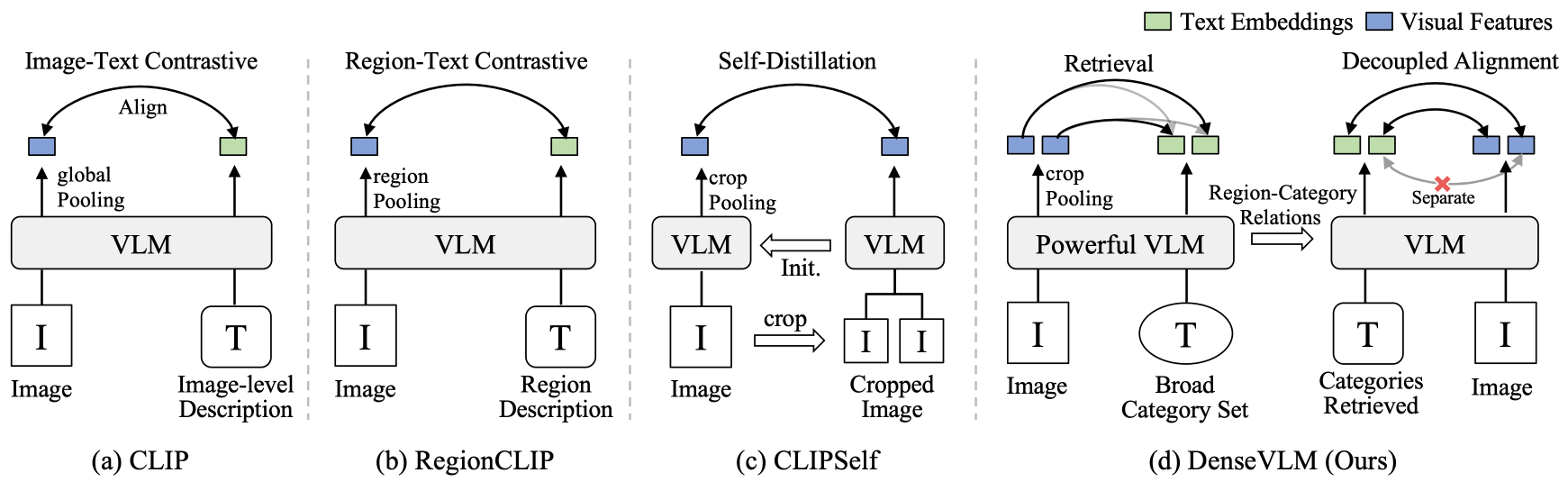
DenseVLM is an unsupervised fine-tuning framework, which retrieves region-level semantics from a powerful vision-language model and decouples foreground and background features to achieve unbiased region-language alignment.
Cascade-CLIP: Cascaded Vision-Language Embeddings Alignment for Zero-Shot Semantic Segmentation
Yunheng Li, Zhong-Yu Li, Quansheng Zeng, Qibin Hou#, Ming-Ming Cheng
[Paper] [Code] [中译版] [集智书童] [Poster]
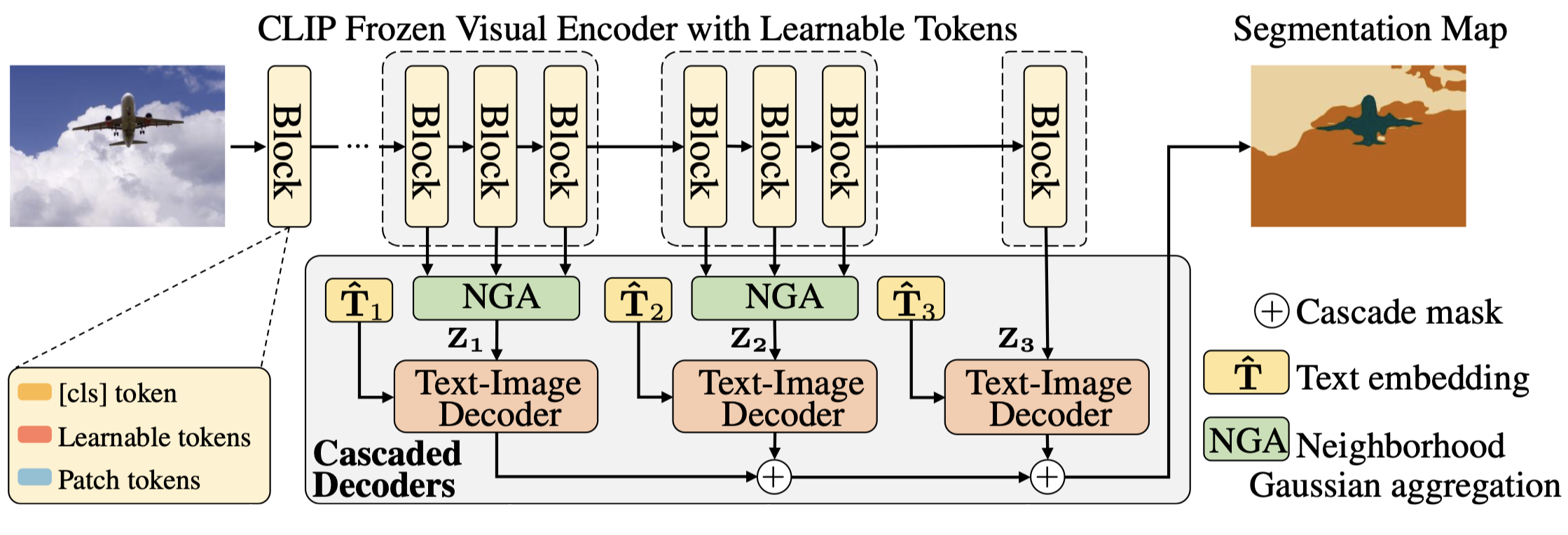
Cascade-CLIP aligns vision-language embeddings via cascaded manner, effectively leveraging CLIP’s multi-level visual features for better zero-shot segmentation.
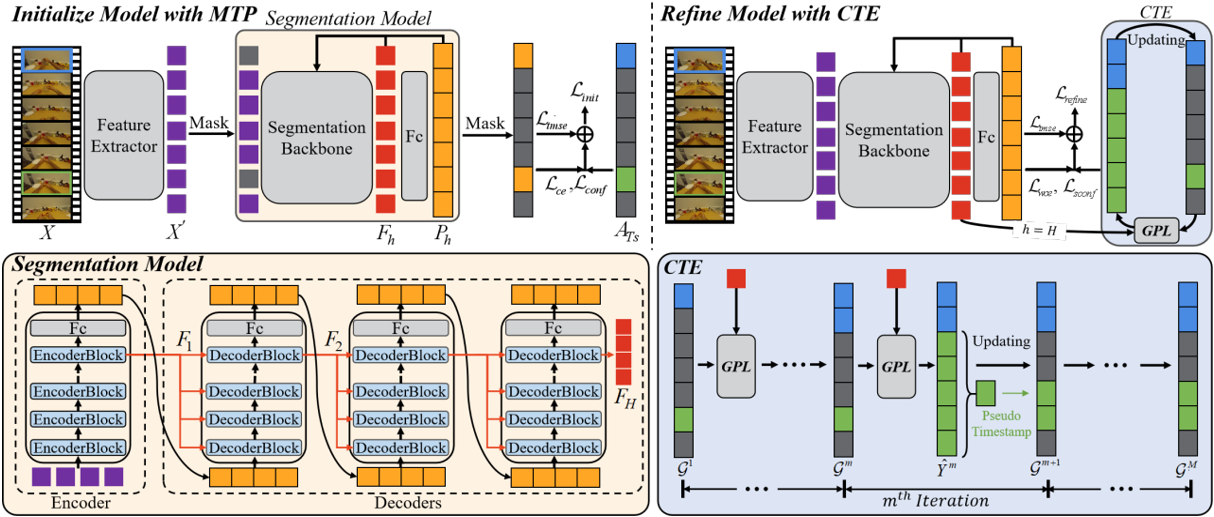
Reducing the Label Bias for Timestamp Supervised Temporal Action Segmentation
Kaiyuan Liu*, Yunheng Li*, Shenglan Liu#, Chenwei Tan, Zihang Shao
D-TSTAS employs a masked timestamp prediction method to reduce dependency on timestamps and a center-oriented timestamp expansion technique to capture semantic-rich motion representations.
Journal
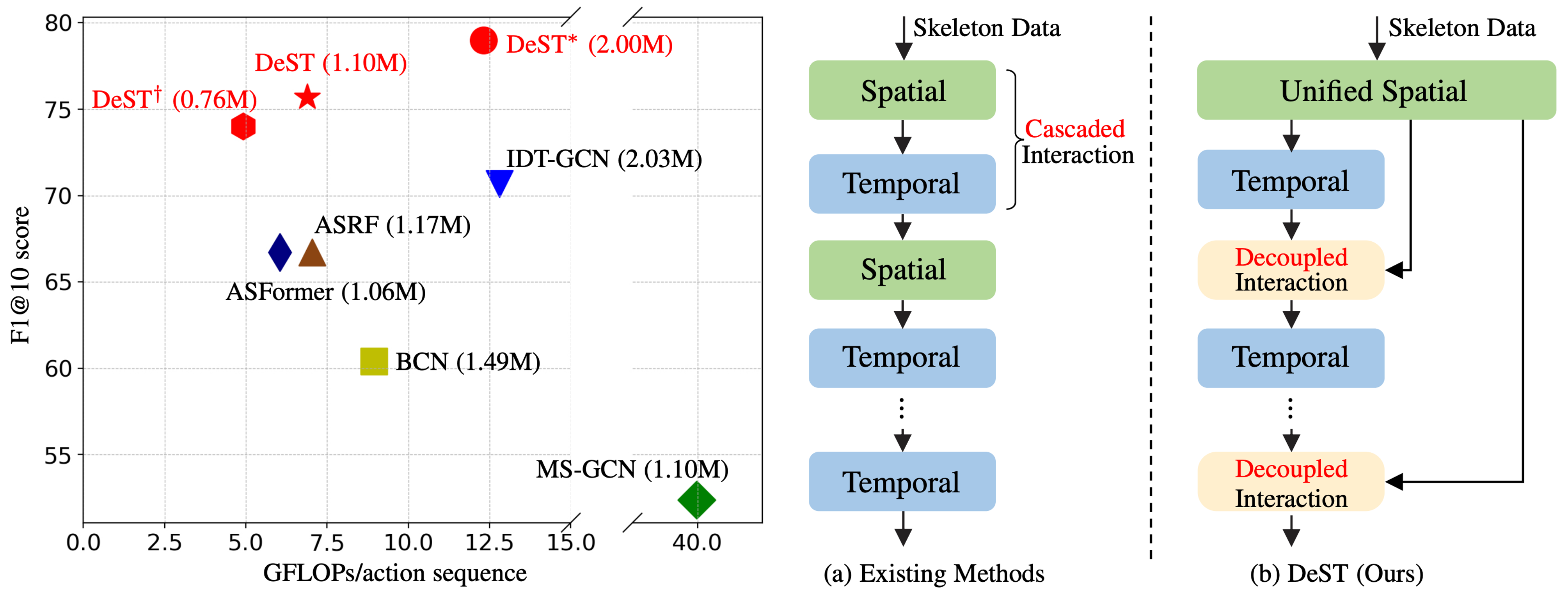
A Decoupled Spatio-Temporal Framework for Skeleton-based Action Segmentation
Yunheng Li, Zhong-Yu Li, Shanghua Gao, Qilong Wang, Qibin Hou#, Ming-Ming Cheng
Decoupled Spatio-Temporal (DeST) framework is the first to decouple spatio-temporal modeling for effective skeleton-based action segmentation.
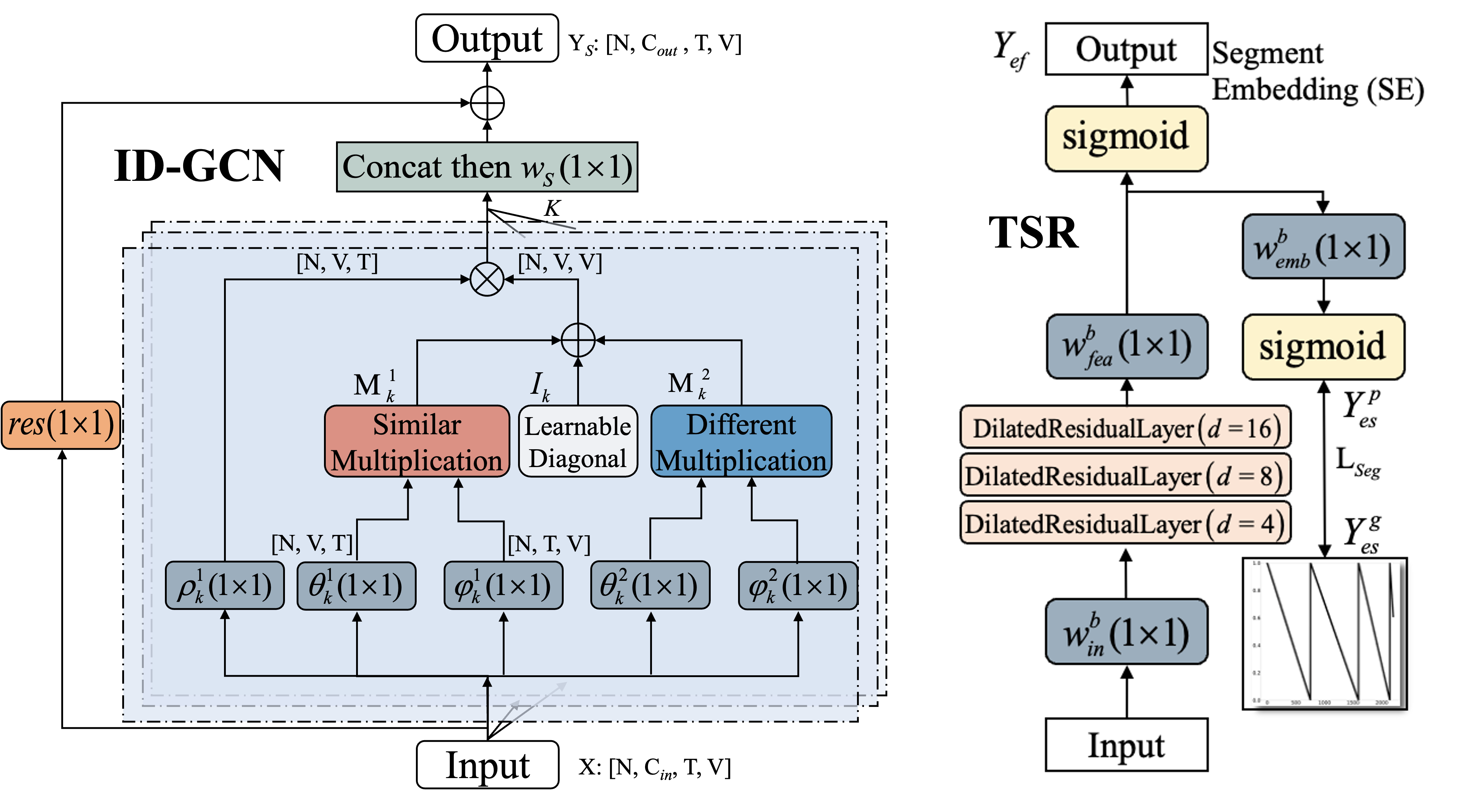
Yunheng Li, Kai-Yuan Liu, Sheng-Lan Liu#, Lin Feng, Hong Qiao
IDT-GCN employs an Involving Distinction Graph Convolutional Network (ID-GC) to effectively capture both similar and differential dependencies among spatial joints through multiple adaptive topologies. Additionally, Temporal Segment Regression (TSR) is used to model action sequences.
📃 Others
SM3Det: A Unified Model for Multi-Modal Remote Sensing Object Detection. AAAI, 2026 Oral.
Yuxuan Li, Xiang Li, Yunheng Li, et al. [Paper] [Code]
A Glimpse to Compress: Dynamic Visual Token Pruning for Large Vision-Language Models. IEEE TCSVT, 2026.
Quan-Sheng Zeng, Yunheng Li, et al. [Paper] [Code] [Models]
Revisiting Efficient Semantic Segmentation: Learning Offsets for Better Spatial and Class Feature Alignment. IEEE ICCV, 2025.
Shicheng Zhang, Yunheng Li, et al. [Paper] [Code]
Spatial Focus Attention for Fine-grained Skeleton-based Action Tasks. IEEE SPL, 2022. Kaiyuan Liu, Yunheng Li, et al. [Paper]
Double Attention Network Based on Sparse Sampling. IEEE ICME, 2022. Zhuben Dong, Yunheng Li, et al. [Paper]
Efficient Two-Step Networks for Temporal Action Segmentation. Neurocomputing, 2021. Yunheng Li, Zhuben Dong, Kaiyuan Liu, et al. [Paper] [Code]
Temporal Segmentation of Fine-gained Semantic Action: A Motion-centered Figure Skating Dataset. AAAI, 2021. Shenglan Liu, Aibin Zhang*, Yunheng Li*, et al. [Paper] [Datasets]
🛠️ Orobot: Ball-Wheel Self-Balancing Robot
🎓 Education
- 2023.09 - Present, Ph.D. Candidate in Computer Science and Technology, Nankai University, Tianjin, China.
- 2020.09 - 2023.06, M.S. in Computer Science and Technology, Dalian University of Technology, Dalian, China.
- 2016.09 - 2020.06, B.S. in Electrical Engineering and Automation, Dalian University of Technology, Dalian, China.
👥 Services
- Conference: CVPR; ICCV; NeurIPS; ICML; ICLR; ECCV; etc.
- Journal: IEEE TCSVT; Neurocomputing.